

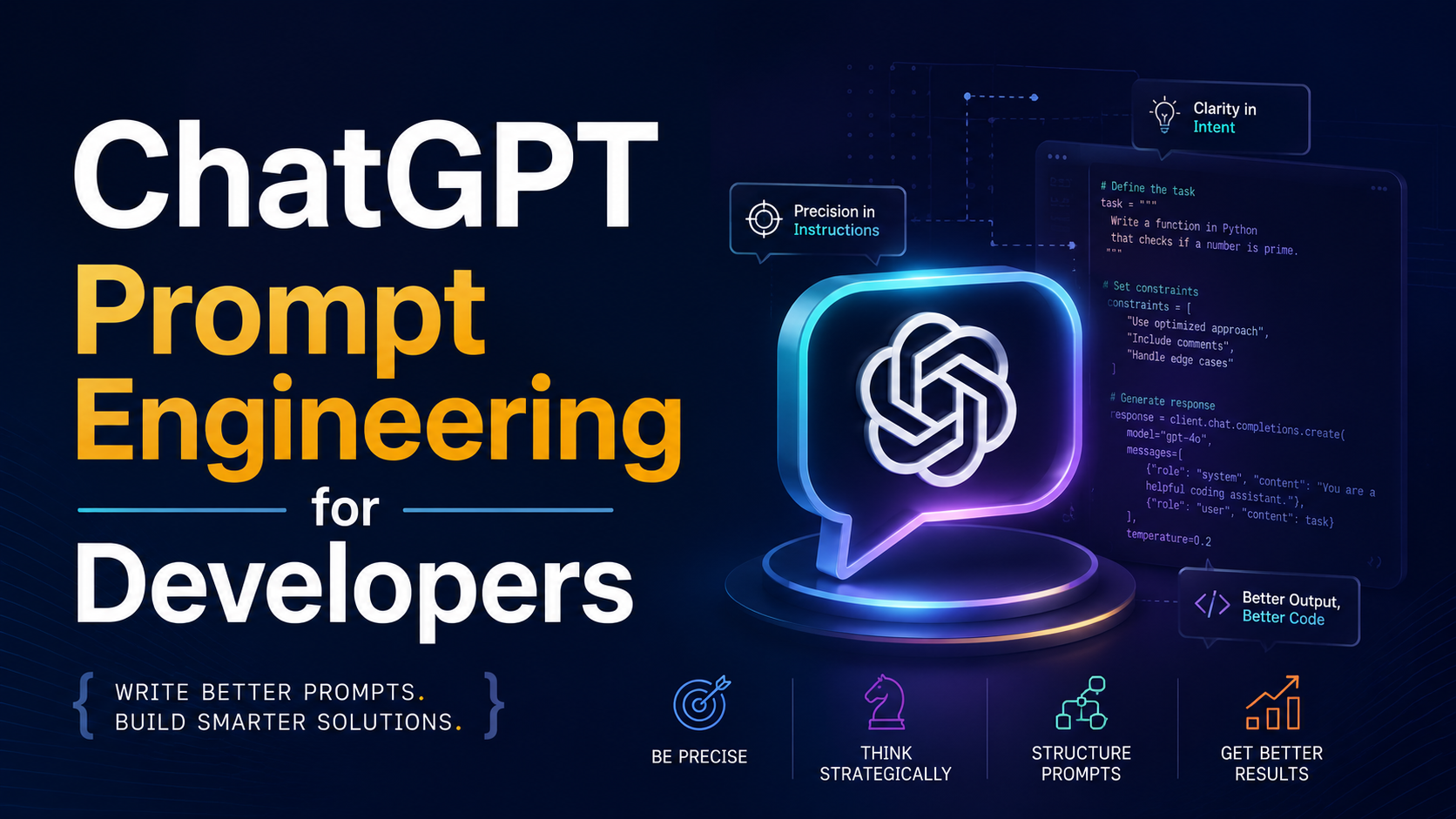

Why Developers Need Prompt Engineering Skills in 2026:
Chatgpt prompt engineering for developers: If you’re a developer in 2026, ChatGPT isn’t just a novelty tool—it’s a critical skill. Developers who master prompt engineering can write better code faster, debug more efficiently, and architect smarter solutions. The difference between a mediocre prompt and a perfectly crafted one? Sometimes it’s the difference between a 30-minute coding session and spending an entire afternoon fixing bugs.
This guide walks you through advanced prompt engineering techniques specifically designed for developers, with real examples you can implement immediately.

What You’ll Learn Today:
- Core principles of effective prompt engineering
- Developer-specific prompting strategies
- Prompt templates that actually work
- Common mistakes and how to avoid them
- Real-world examples you can steal and adapt
Understanding Prompt Engineering Fundamentals for Developers
Why Generic Prompts Fail Developers
Here’s what most developers do wrong:
❌ BAD: "Write me a function to sort an array"
✅ GOOD: "Write a TypeScript function that sorts an array of objects
by the 'createdAt' timestamp in descending order. Use functional
programming principles and include JSDoc comments."
The second prompt works because it specifies language, data structure, sorting order, and coding style. ChatGPT now knows exactly what to deliver.
Advanced Prompt Engineering Best Practices for Developers
The “Role + Context + Task” Framework
The most effective prompt engineering formula combines three elements:
1. Role Definition Tell ChatGPT what expertise it should embody:
"You are a senior React developer with 10 years of experience
building scalable applications."
2. Context Provision Explain the situation:
"We're building a real-time dashboard for a SaaS application
handling 100K+ daily active users."
3. Task Specification Be crystal clear about what you want:
"Create an optimized React component that fetches data every 30
seconds without causing unnecessary re-renders. Use React Query
for state management."
Complete Prompt:
You are a senior React developer with 10 years of experience building
scalable applications. We're building a real-time dashboard for a SaaS
application with 100K+ daily active users. Create an optimized React
component that fetches data every 30 seconds without causing unnecessary
re-renders. Use React Query for state management. Include error handling
and loading states.
The Chain-of-Thought Technique for Complex Problems
When dealing with complex algorithms or architectural decisions, ask ChatGPT to think through the problem step-by-step:
"I need to optimize this database query that currently runs 15 seconds
on production data. Let's think through this step by step:

1. First, explain what might be causing the slow performance
2. Then suggest 3 different optimization approaches
3. Finally, provide code for the best approach with explanations
This technique significantly improves the quality of responses for intricate problems.
More Developer Resources
Developer-Specific ChatGPT Prompt Engineering Strategies
Code Review and Optimization Prompts
"Review this JavaScript code for:
- Performance bottlenecks
- Security vulnerabilities
- Best practice violations
- Readability issues

Provide specific suggestions and refactored code examples:

[YOUR CODE HERE]

Focus on modern JavaScript practices and ES2024 standards."
Architecture and Design Decision Prompts
"I'm architecting a microservices system that needs to handle:
- 10,000 requests per second
- Multiple payment processors
- Real-time notifications
- User authentication and authorization

What architectural pattern would you recommend? Consider:
1. Scalability requirements
2. Maintenance complexity
3. Technology trade-offs
4. Cost implications

Provide a detailed architecture diagram description and implementation steps."
Debugging and Troubleshooting Prompts
"I'm getting this error in my [LANGUAGE] application:
[ERROR MESSAGE AND STACK TRACE]

The error occurs when [SPECIFIC CONDITIONS]. I've already tried:
1. [SOLUTION 1]
2. [SOLUTION 2]

Please help me debug by:
1. Explaining what's likely causing this
2. Suggesting three debugging approaches
3. Providing code fixes with explanations"
Proven ChatGPT Prompt Templates You Can Copy-Paste
Template #1 – API Integration Prompt
"I need to integrate the [API_NAME] API into my [TECH_STACK] application.

Requirements:
- Authentication method: [AUTH_TYPE]
- Rate limiting: [LIMITS]
- Error handling needed for: [SCENARIOS]
- Response data I need: [FIELDS]

Create complete code including:
1. Configuration setup
2. API request functions
3. Error handling
4. Response caching (if applicable)
5. Unit tests"
Template #2 – Performance Optimization Prompt
"My [FRAMEWORK/LANGUAGE] application is experiencing performance issues:
- Current load time: [TIME]
- Target load time: [TIME]
- Current memory usage: [AMOUNT]
- User base: [NUMBER]

The bottleneck appears to be in: [AREA]

Please provide:
1. Root cause analysis
2. Three optimization strategies ranked by impact
3. Implementation code with before/after comparisons
4. Testing approach"
Template #3 – Feature Implementation Prompt
"I'm building a [FEATURE] in [FRAMEWORK].

User requirements:
- [REQUIREMENT 1]
- [REQUIREMENT 2]
- [REQUIREMENT 3]

Technical constraints:
- [CONSTRAINT 1]
- [CONSTRAINT 2]

Provide:
1. Component/function architecture
2. Complete implementation code
3. Testing strategy
4. Edge cases to handle
5. Performance considerations"
Common ChatGPT Prompt Engineering Mistakes (And How to Fix Them)
Mistake #1: Vague Language
❌ "Make this faster"
✅ "Optimize this function to reduce response time from 500ms to under 100ms
while maintaining accuracy"
Mistake #2: Missing Context
❌ "How do I use this library?"
✅ "I'm using [LIBRARY] in a React 18 application with TypeScript. I need
to implement real-time data syncing. Show me how to use [LIBRARY] for this
specific use case."
Mistake #3: Not Specifying Output Format
❌ "Write a function"
✅ "Write a TypeScript function with the following signature:
function [NAME]([PARAMS]): [RETURN_TYPE] { ... }
Include JSDoc comments and handle these error cases: [CASES]"
Real-World Developer Scenarios & Prompt Examples
Scenario 1: Building a Real-Time Chat Feature
"I'm adding a real-time chat feature to my Next.js 14 application.
The chat needs to:
- Support 1000+ concurrent connections
- Persist messages to PostgreSQL
- Send notifications to offline users
- Support typing indicators

Tech stack: Next.js 14, WebSockets, Redis, PostgreSQL

Provide:
1. System architecture
2. Server-side implementation
3. Client-side React components
4. Database schema
5. Testing approach"
Scenario 2: Migrating Legacy Code
"I have a legacy Python 2 script that processes CSV files and
generates reports. I need to modernize it to Python 3.11 with:
- Better error handling
- Unit tests
- Performance improvements
- Cleaner code structure

The script currently:
[PASTE CODE HERE]

Show me the refactored version with explanations for each change."
Advanced Techniques for Mastering Chatgpt Prompt Engineering for Developers
The Multi-Turn Conversation Strategy
Don’t ask everything at once. Instead:
- First turn: Get the high-level solution
- Second turn: Ask for optimization
- Third turn: Request error handling
- Fourth turn: Ask for testing code
This iterative approach produces better results than one giant prompt.
The “Show Your Work” Requirement
"Before providing code, show your step-by-step thinking:
1. What problem are we solving?
2. What are the constraints?
3. What's the optimal approach?
4. What are potential pitfalls?
Then provide the implementation."
The Comparison Technique
"Show me two different approaches to [PROBLEM]:
- Approach A: [DESCRIPTION]
- Approach B: [DESCRIPTION]

For each approach, provide:
1. Pros and cons
2. Performance implications
3. Code example
4. When to use each approach"
FAQ’s About Chatgpt prompt engineering for developers
Q1: How long should my prompts be? A: As long as necessary to provide context. Most effective developer prompts range from 150-400 words. Quality matters more than brevity.
Q2: Should I be specific about ChatGPT version? A: Yes! Always mention which ChatGPT version (GPT-4, GPT-4 Turbo, etc.) and your specific requirements. Different versions have different capabilities.
Q3: How do I handle proprietary code in prompts? A: Never paste actual proprietary code. Instead, describe it anonymously: “I have a React component that does X” rather than sharing your actual code.
Q4: Can I use ChatGPT prompts for production code directly? A: No! Always review, test, and refactor ChatGPT output. It’s a starting point, not a finished product. Especially critical for security-sensitive code.
Q5: How often should I update my prompt engineering strategy? A: As ChatGPT capabilities evolve, revisit your strategies quarterly. What worked last year might be less efficient now.
REVIEW THIS SHORT COURSE: ChatGPT Prompt Engineering for Developers


Leave a Reply