

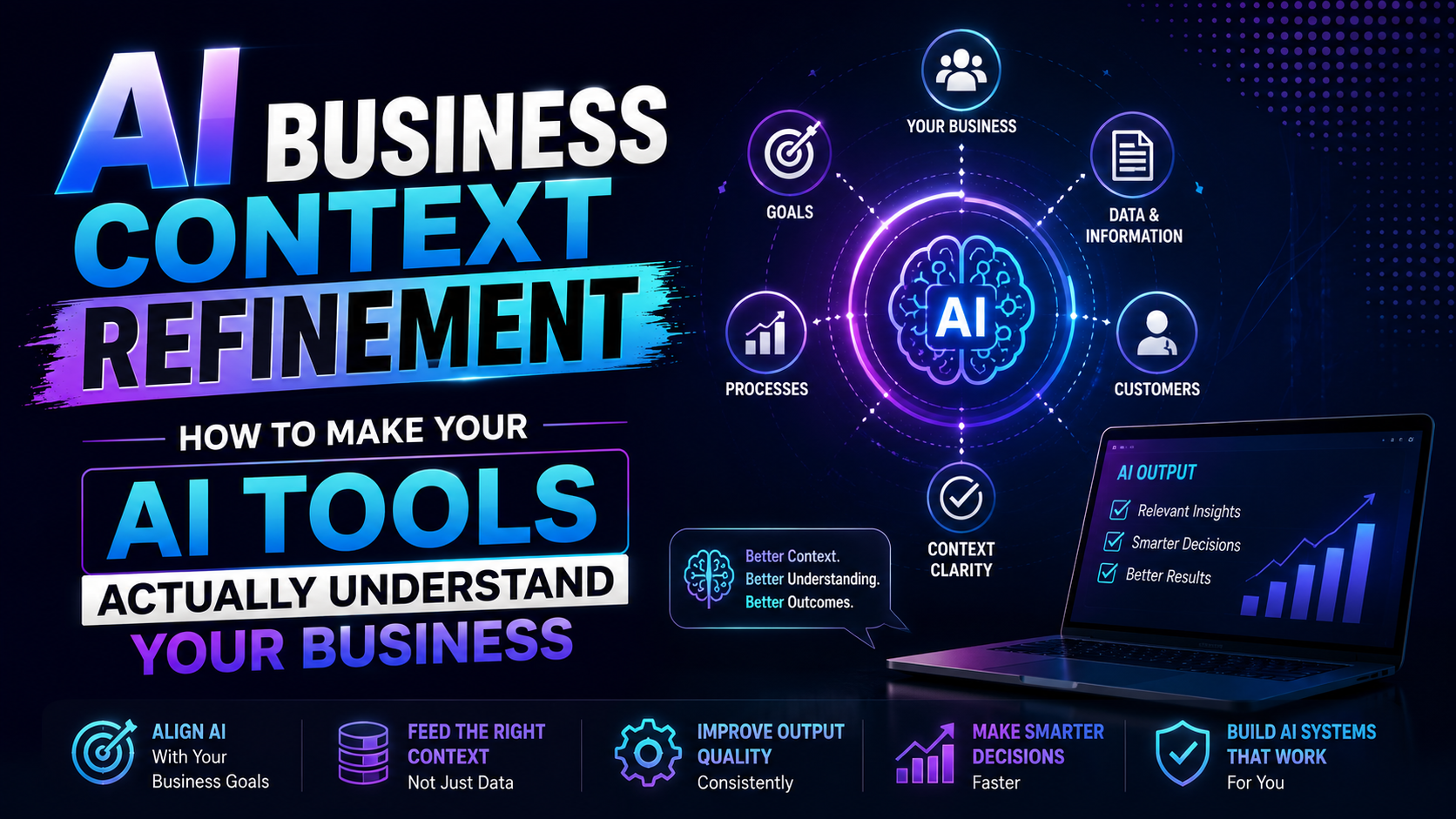

AI Business Context Refinement: How to Make Your AI Tools Actually Understand Your Business:
If you’ve ever asked an AI tool a question about your own business and gotten a generic, slightly-off answer, you’ve run into the core problem this article solves. The AI isn’t broken — it just doesn’t know your business. That’s where AI business context refinement comes in.
This is the process of feeding AI systems the right information, in the right format, so their outputs actually reflect how your company operates, who your customers are, and what “good” looks like for your specific industry. Done well, it’s the difference between an AI assistant that feels like a new hire who’s been onboarded properly, and one that’s still reading from a generic script.
In this guide, you’ll learn what context refinement actually means, why it matters more than most people realize, and the practical steps to implement it — whether you’re using AI for customer support, content creation, sales, or internal operations.
What Is AI Business Context Refinement?
At its simplest, AI business context refinement is the ongoing process of curating, structuring, and updating the information an AI system uses to understand your business. This isn’t a one-time setup. It’s closer to AI context management — an active practice, not a checkbox.
Most AI tools start with a blank slate. They know general facts about the world, but nothing about your pricing model, your tone of voice, your top customer objections, or the three things that make your product different from a competitor’s. Context refinement fills that gap.
This typically involves:
Feeding the AI structured documents (product specs, FAQs, brand guidelines, past support tickets)
Correcting outputs when they’re inaccurate, so the system “learns” your preferences
Removing outdated or conflicting information that confuses results
Organizing information so the AI can retrieve the right piece of context at the right time
Why Context Refinement Matters for Your Business
Generic AI Output Costs You Trust
When a customer-facing AI gives a wrong answer about your return policy or pricing, that’s not a minor glitch — it’s a trust problem. People remember bad AI interactions, and they tend to assume the business itself is sloppy.
Better Context Means Faster, Cheaper Operations:
A well-structured business AI data strategy reduces the number of times employees have to double-check or rewrite AI output. That time savings compounds. Teams that invest in context refinement early often report needing far less manual editing of AI-generated drafts, summaries, or responses within a few months.
It’s a Competitive Differentiator
Two companies can use the exact same AI tool and get wildly different results. The difference almost always comes down to context. The business that’s done the work to refine what the AI knows will consistently produce sharper, more relevant outputs than one that hasn’t.
How to Build a Strong AI Business Context Refinement Process:
1. Audit What the AI Currently “Knows”
Start by testing your existing AI tools with real, specific questions about your business. Ask about pricing tiers, refund policies, product comparisons, or recent announcements. Wherever the answer is wrong, vague, or outdated, that’s your starting list of gaps to fix.
2. Build a Centralized Knowledge Base
Rather than scattering information across emails, Slack threads, and old slide decks, consolidate it. An AI knowledge base for business should include:
Core product or service documentation
Brand voice and tone guidelines
Common customer questions and approved answers
Internal policies relevant to AI-assisted tasks
3. Prioritize Recency Over Volume
More documents isn’t automatically better. Outdated pricing sheets or old org charts sitting in your knowledge base can actively mislead the AI. Set a regular review cadence — quarterly works well for most teams — to retire stale content.
4. Use Feedback Loops, Not One-Off Fixes
When an AI tool gives an inaccurate or off-brand response, don’t just fix that one instance. Trace back why it happened. Was the source document missing? Ambiguous? Conflicting with another doc? Fixing the root cause prevents the same error from resurfacing.
5. Tailor Context by Use Case
The context your sales team needs an AI to draw on (competitor positioning, objection handling) is different from what your support team needs (troubleshooting steps, refund policy). Segmenting context by department or use case keeps outputs sharper and more relevant.
Common Mistakes Businesses Make:
Treating it as “set and forget.” Context decays. A product launch, a policy change, or a rebrand can make last quarter’s context obsolete overnight.
Overloading the system with irrelevant detail. More isn’t better — relevance is. Dumping your entire internal wiki into an AI tool often produces worse, not better, results.
Skipping human review. Even refined context needs spot-checking. AI output should be reviewed periodically, especially for anything customer-facing.
Ignoring tone and voice. Factually correct output that doesn’t sound like your brand still feels “off” to readers and customers.
(If your team is local to your region and works with an AI consultant or agency, it’s worth asking whether they offer ongoing context refinement support rather than a one-time setup — this is where a lot of long-term value gets left on the table.)
How Often Should You Refine Your AI’s Business Context?
For most businesses, a quarterly review is a reasonable baseline, with smaller updates triggered by specific events — a new product launch, a policy change, a rebrand, or a noticeable pattern of AI errors. Fast-moving industries may need monthly check-ins; slower-moving ones can often go longer between full reviews.
Frequently Asked Questions
What is AI business context refinement in simple terms?
It’s the process of giving an AI system accurate, organized, up-to-date information about your business so its responses are relevant and correct — rather than generic.
Is this the same as training an AI model?
Not usually. Most businesses aren’t retraining the underlying model itself — they’re managing the context (documents, instructions, examples) that the AI references when generating a response. It’s closer to good onboarding than to model engineering.
How long does it take to see results?
Many teams notice meaningfully better AI output within a few weeks of organizing their core documents, though full refinement is an ongoing process rather than a single project.
Do small businesses need this, or just large enterprises?
Any business using AI tools for customer-facing or decision-relevant tasks benefits from this. Smaller businesses often see results faster, simply because there’s less existing information to organize.
What’s the biggest mistake to avoid?
Letting context go stale. Outdated information is often worse than no information, since it can confidently mislead both the AI and the people relying on its output.
Final Thoughts:
AI tools are only as useful as what they know about your business — and that’s entirely within your control. AI business context refinement isn’t a one-time technical project; it’s an ongoing habit, much like keeping your website content or internal documentation up to date.
If you’re ready to get more accurate, on-brand results from the AI tools you’re already using, start small: audit one AI tool’s current output against reality, fix the biggest gaps first, and build a review habit from there.



Leave a Reply