

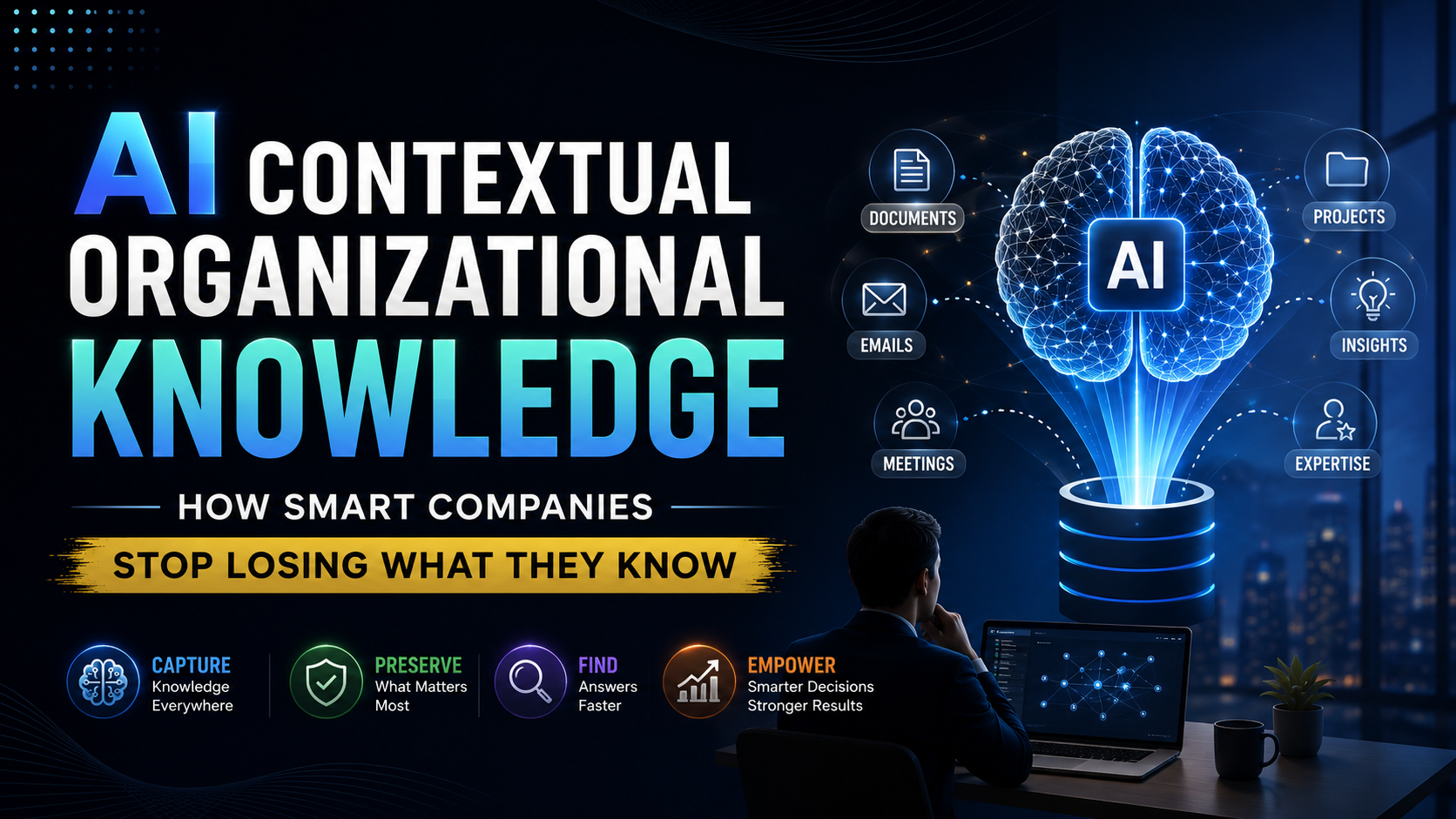

AI Contextual Organizational Knowledge: How Smart Companies Stop Losing What They Know
Every engineering team has lived this moment: a senior employee leaves, and three weeks later someone discovers that the only documentation for a critical system lived entirely in that person’s head. Multiply that by every Slack thread, every half-finished Confluence page, and every tribal-knowledge Zoom call your company has ever had, and you get a sense of the problem AI contextual organizational knowledge is built to solve.
This isn’t just another knowledge-base buzzword. It’s a shift in how systems retrieve, connect, and surface information based on actual context — who’s asking, what they’re working on, and what’s actually relevant right now — rather than just matching keywords. For technical decision-makers evaluating tools, the real question isn’t “should we adopt this?” It’s “which architecture actually fits how our org generates and consumes knowledge?”
In this guide, we’ll break down the leading approaches to AI-powered knowledge management, compare their tradeoffs, and help you figure out which path makes sense for your environment.
What AI Contextual Organizational Knowledge Actually Means:
At its core, AI contextual organizational knowledge refers to systems that don’t just store information — they understand it in relation to your company’s structure, history, and ongoing work. Instead of a static search bar returning a list of documents, you get answers that account for context: project history, team ownership, recency, and relevance to the person asking.
This matters because traditional enterprise knowledge management tools were built for an era of folders and tags. They assume people know exactly what they’re looking for and exactly which document contains it. In practice, most knowledge work doesn’t function that way. Questions are messy, partial, and dependent on context that lives across a dozen disconnected tools.
Why Traditional Knowledge Bases Fall Short:
Before comparing modern approaches, it’s worth being clear about what’s broken. Most organizations already have an AI knowledge base of sorts — a wiki, a shared drive, a ticketing system. The problems usually aren’t about volume of information; they’re about retrieval and context:
Keyword mismatch. Someone searches “deployment process” but the doc is titled “release pipeline.” Nothing returns.
Staleness. Old documentation outranks current docs because it has more inbound links or higher view counts.
No ownership signal. The system can’t tell you who actually knows the answer or when a document was last validated.
Siloed context. Information that lives in Slack, Jira, and email never gets unified, so any single search only sees a fraction of the picture.
These gaps are exactly what newer architectures are trying to close.
Comparing the Core Approaches to Contextual AI:
There isn’t one “correct” architecture for organizational AI — there are tradeoffs depending on your data, scale, and existing infrastructure. Here’s how the major approaches stack up.
Retrieval-Augmented Generation (RAG)
RAG pairs a large language model with a retrieval layer that pulls relevant documents at query time, then feeds them into the model as context before it generates a response. It’s currently the most widely adopted method for contextual AI search.
Strengths: Relatively fast to implement, works well with existing document stores, and doesn’t require retraining a model every time content changes.
Limitations: Quality depends heavily on chunking strategy and embedding quality. Poorly chunked documents lead to fragmented, sometimes contradictory answers. RAG also struggles with multi-hop reasoning — questions that require connecting facts across several documents.
Best fit: Organizations with large, relatively static document repositories (policy docs, technical documentation, support articles) where the priority is fast, accurate retrieval over qualitative reasoning.
Knowledge Graphs:
Knowledge graphs represent information as entities and relationships — people, projects, systems, decisions — connected by explicit links. Rather than retrieving chunks of text, the system traverses relationships to answer questions like “who owns this service and what depends on it?”
Strengths: Excellent for institutional knowledge retention where relationships matter more than raw text — org structure, system dependencies, decision lineage. Answers tend to be more explainable since you can trace the reasoning path.
Limitations: Building and maintaining a graph requires more upfront structuring effort. It’s not great at handling unstructured, free-text content without a layer on top of it.
Best fit: Technical organizations where dependency mapping, ownership, and relationship reasoning matter — think infrastructure teams, compliance-heavy industries, or anywhere “who is responsible for X” is a recurring question.
Vector Search and Embeddings:
Vector search converts text into numerical representations (embeddings) and finds semantically similar content, even when exact keywords don’t match. It’s often used as the retrieval backbone inside RAG systems but can also stand alone for semantic search use cases.
Strengths: Captures meaning rather than literal phrasing, which solves the “deployment process” vs. “release pipeline” problem directly.
Limitations: Embeddings can drift in quality depending on the model used, and results can be “approximately right” without being precisely accurate — a risk in compliance or technical-accuracy contexts.
Best fit: Search-heavy use cases where semantic relevance is the priority and exact-match precision is less critical.
Hybrid Architectures:
In practice, most mature implementations of AI-powered knowledge management combine these approaches: vector search for retrieval, a knowledge graph for relationship context, and an LLM layer for generating natural-language answers. This hybrid model tends to outperform any single approach on its own, at the cost of added implementation complexity.
Key Factors When Choosing an Approach
When evaluating tools or architectures, technical teams should weigh:
Data structure — Is most of your knowledge in unstructured docs, structured systems (like CMDBs), or both?
Update frequency — Static documentation favors RAG; rapidly changing systems favor graph-based or hybrid models that can reflect live relationships.
Explainability requirements — Regulated industries often need traceable reasoning, which favors knowledge graphs over pure vector retrieval.
Integration surface — How many existing tools (Slack, Jira, Confluence, Git) need to feed into the system, and does the vendor support those connectors natively?
Total cost of maintenance — Graph-based systems often cost more to maintain long-term; vector/RAG systems cost less upfront but need ongoing tuning of retrieval quality.
Common Pitfalls in Implementation
Even well-chosen architectures fail in predictable ways:
Treating it as a one-time project. Knowledge systems degrade without ongoing curation and feedback loops.
Ignoring access control. Contextual systems can inadvertently surface sensitive information to the wrong audience if permissions aren’t mapped correctly into the retrieval layer.
Skipping evaluation metrics. Teams often deploy without a clear way to measure answer accuracy, leading to silent quality decay over time.
Frequently Asked Questions
What is AI contextual organizational knowledge? It’s the use of AI systems to retrieve and connect organizational information based on context — relationships, recency, and relevance — rather than simple keyword matching.
Is RAG or a knowledge graph better for enterprise use? Neither is universally better. RAG suits large, mostly static text repositories; knowledge graphs suit use cases where relationships and explainability matter more than raw text retrieval.
How long does it take to implement a contextual knowledge system? Basic RAG implementations can launch in weeks. Knowledge graph and hybrid systems typically take longer due to data modeling and integration work.
Does this replace our existing wiki or knowledge base? Usually not immediately — most organizations layer contextual AI on top of existing tools rather than replacing them outright.
How do we measure if it’s actually working? Track retrieval accuracy, time-to-answer, and user-reported relevance. Without these metrics, quality issues go unnoticed until they cause real damage.
Choosing the Right Path Forward:
There’s no single best answer to which approach wins — the right choice depends on your data, your team’s tolerance for implementation complexity, and how much explainability your use case demands. Start by auditing where your knowledge actually lives and how often it changes, then match that reality to the architecture that fits, rather than chasing whichever tool is trending.
If you’re at the evaluation stage, the smartest next step is a small pilot — pick one team, one use case, and one architecture, and measure real retrieval accuracy before committing to a company-wide rollout.


Leave a Reply