



Introduction
Remember when artificial intelligence felt like distant science fiction? Those days are gone. In 2026, AI is reshaping careers, creating opportunities, and—honestly—raising some serious questions about earning potential.
If you’ve stumbled across “prompt engineering” and wondered if it’s actually a real career path with real money behind it, you’re not alone. The short answer? Absolutely yes. But here’s what makes it interesting: you don’t need a computer science degree, coding experience, or years of tech credentials to break into this field.
This guide walks you through real prompt engineer salary data, job market trends, and exactly how to position yourself for these increasingly lucrative roles. Whether you’re considering a career pivot or just curious about where AI jobs are heading, we’ve got the answers.
See Indeed Insights: Click Here
How Much Do AI Prompt Engineers Earn? 2026 Salary Breakdown
Let’s get to the part you probably clicked for: the money.
Prompt engineer salary ranges vary widely depending on several factors:
- Entry-level positions: $50,000–$75,000 annually
- Mid-level roles: $75,000–$130,000 annually
- Senior/specialized positions: $130,000–$200,000+ annually
- Contract/freelance rates: $50–$200+ per hour (depending on expertise and client tier)
The average prompt engineer salary in the United States hovers around $90,000–$110,000 as of 2026, though this shifts based on location, experience, and employer type.
What’s driving these numbers?
Prompt engineer jobs salary tends to be highest at FAANG companies (Google, Apple, Meta) and cutting-edge AI startups. These organizations treat prompt engineering as a specialized, revenue-impacting role. Smaller companies may offer less, but they often provide flexibility or equity compensation.
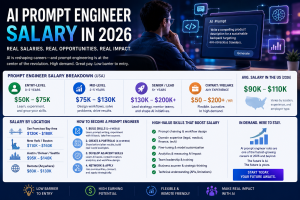
Prompt Engineer Salary by Experience Level: Career Path & Earnings
Understanding the salary progression helps you set realistic expectations and plan your trajectory.
Junior Prompt Engineer (0–2 years)
Entry into the field is competitive but achievable. You’ll likely earn $50,000–$70,000 and focus on learning prompt design principles, testing different approaches, and understanding how AI models respond to various inputs. Companies often hire junior prompt engineers if you can demonstrate curiosity and quick learning ability.
Mid-Level Prompt Engineer (2–5 years)
With proven results and a portfolio of successful projects, mid-level prompt engineers command $85,000–$120,000. At this stage, you’re not just writing prompts—you’re designing AI workflows, training internal teams, and solving complex business problems. Your value increases substantially.
Senior/Lead Prompt Engineer (5+ years)
Senior roles focusing on AI strategy, team leadership, and enterprise solutions bring $130,000–$200,000+ (plus bonuses and stock options at larger firms). You’re shaping AI strategy, mentoring teams, and directly impacting company-wide AI initiatives.
AI Prompt Engineer Salary in the US by Region
Location matters more than you’d think:
- San Francisco Bay Area: $120,000–$180,000 (highest cost of living, but top-tier AI companies)
- New York/Boston: $110,000–$160,000
- Austin/Denver/Seattle: $95,000–$140,000
- Remote roles: $80,000–$130,000 (location-agnostic, increasingly common)
Remote work has democratized prompt engineering salaries—you can now earn competitive San Francisco wages while living anywhere with internet access.
How to Become an AI Prompt Engineer: The Realistic Path
Here’s the truth: you don’t need a degree. But you do need strategy.
Step 1: Build foundational prompt writing skills (2–4 weeks) Start with free resources. Spend time with ChatGPT, Claude, or other AI tools. Experiment. Write detailed prompts. Observe what works and what doesn’t. Take free courses on platforms like Coursera or YouTube.
Step 2: Create a practical portfolio (4–8 weeks) Document your best work. Show before-and-after prompt improvements. Build examples across different domains: marketing copy, customer service automation, content generation, data analysis. Employers want proof you can deliver results.
Step 3: Develop adjacent skills While prompt writing is core, employers also value:
- Basic understanding of AI/ML concepts
- Experience with content creation or copywriting
- Project management or workflow optimization
- Data literacy and ability to measure AI output quality
Step 4: Network and apply strategically Join AI communities (Twitter/X, LinkedIn, Discord servers focused on AI). Follow companies using AI heavily. Apply for roles like “AI Operations Specialist,” “AI Training Specialist,” or “Prompt Optimization Specialist”—companies use different job titles for similar work.
Skills That Increase Your Prompt Engineer Salary
Not all prompt engineers earn the same. Specific skills create earning leverage.
High-value skills that boost compensation:
- Prompt chaining & workflow design – Creating complex multi-step AI processes
- Domain expertise – Legal, medical, financial, or technical knowledge makes you invaluable
- Fine-tuning knowledge – Understanding how to train or customize models
- Analytics & measurement – Proving AI ROI through data
- Team leadership – Managing AI operations or training others
- Business acumen – Speaking the language of revenue, efficiency, and risk
- Technical understanding – Basic API knowledge, understanding model limitations
Engineers who combine prompt expertise with one specialized domain (like legal tech or healthcare) often command 20-40% salary premiums.
Are Prompt Engineers in Demand? Job Market Reality Check
The straightforward answer: yes, absolutely. But with nuance.
What the data shows:
Job postings for prompt engineers and related AI roles grew dramatically throughout 2025 and into 2026. LinkedIn reports that “AI Prompt Engineer” is consistently in the top 20 fastest-growing job categories. However, this growth is highly concentrated:
- Tech companies: extremely high demand
- Marketing/content agencies: growing demand
- Financial services: emerging but significant demand
- Traditional industries: slower adoption but increasing
The caveat: Most “prompt engineer” jobs aren’t listed with that exact title. They’re hidden under labels like “AI Operations Manager,” “Content Automation Specialist,” or “AI Training Associate.” That’s why your portfolio matters more than finding the perfect job title.
The Future of Prompt Engineering Salary: What to Expect
Looking ahead to 2027 and beyond, here’s what we’re likely to see:
Salary trajectory: Entry-level positions may consolidate slightly (as more people enter the field), but mid-to-senior salaries will likely increase as companies realize prompt engineering is a permanent business function, not a temporary trend.
Specialization effect: As the field matures, generalist prompt engineers may see salary pressure, but specialists (prompt engineers for healthcare, financial modeling, legal analysis, etc.) will command premiums.
Automation consideration: Some routine prompt work may eventually be automated. However, strategic prompt engineering—understanding context, optimizing for specific business outcomes, training AI models to behave a certain way—will remain in high demand.
FAQ: Your Prompt Engineering Questions Answered
Q: Do I need coding skills to become a prompt engineer? A: No. While some technical understanding helps, strong writing, critical thinking, and business sense matter more. Many successful prompt engineers have backgrounds in writing, marketing, or operations—not computer science.
Q: What’s the fastest way to start earning as a prompt engineer? A: Freelancing. Platforms like Upwork and Fiverr have growing demand for prompt engineering services. You can charge $50–$150+ per hour while building your portfolio. This experience then translates to better full-time opportunities.
Q: Is prompt engineering a stable long-term career? A: Absolutely. As long as large language models remain central to business operations (which they will), prompt engineering expertise will be valuable. The field is evolving, not disappearing.
Q: How quickly can salaries increase for prompt engineers? A: You can realistically move from entry-level ($60K) to mid-level ($100K+) in 2–3 years if you develop specialized expertise and prove measurable impact on business outcomes.
Q: What’s the difference between a prompt engineer and an AI trainer? A: Prompt engineers optimize instructions for existing AI models. AI trainers may be involved in feeding data, labeling content, or fine-tuning models. There’s overlap, but prompt engineers focus on prompting strategy.
Conclusion: Your Move in the AI Economy
Prompt engineering represents one of the few career paths where you can genuinely start from zero, build real expertise in weeks, and command a competitive salary within months. The barrier to entry is remarkably low; the ceiling is remarkably high.
Here’s what we know for certain in 2026:
- The demand is real and growing. Businesses are betting their competitiveness on AI integration.
- The money is there. From $50K entry-level to $200K+ for specialized senior roles.
- You don’t need credentials to start. You need curiosity, strategic thinking, and willingness to build.
Your action steps:
- This week: Spend 10 hours experimenting with ChatGPT or Claude. Build something.
- Next 2 weeks: Take one free course on prompt engineering or AI fundamentals.
- Next month: Create 5 portfolio examples showing real business applications.
- Next 3 months: Apply for junior roles or start freelancing on Upwork.
The AI economy is reshaping work in real-time. Prompt engineers are on the front lines of that transformation. The question isn’t whether there’s opportunity—it’s whether you’ll claim your share of it.
Ready to take the first step? Start experimenting with AI tools today. Your next career move is just one good prompt away.

Leave a Reply