

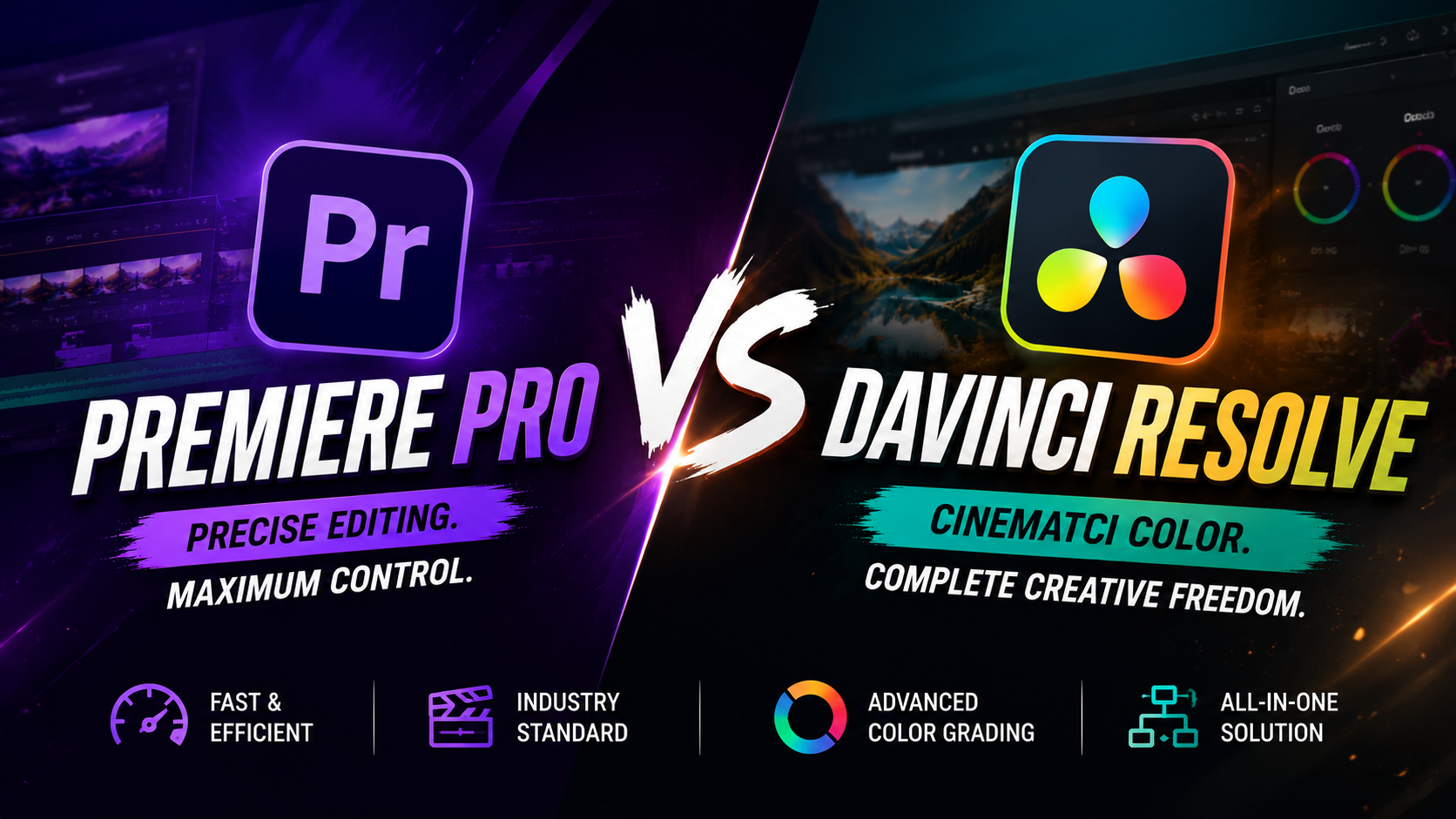

Premiere Pro vs DaVinci Resolve in 2026: Which One Deserves Your Time?
Premiere Pro vs DaVinci Resolve: Every serious video editor eventually runs into this exact debate: stick with Adobe’s subscription-based Premiere Pro, or switch to DaVinci Resolve, a tool that’s genuinely free for most editing work and only asks for a one-time payment if you need its most advanced features. It’s one of the most consequential software decisions a creator can make, since your entire workflow ends up built around whichever one you choose.
This guide breaks down how Premiere Pro and DaVinci Resolve actually compare in 2026, covering pricing, color grading strength, performance, and which one fits different types of creators, so you can make the switch (or stay put) with real information instead of brand loyalty alone.
Premiere Pro vs DaVinci Resolve: Pricing Compared
Premiere Pro’s Subscription Model. Premiere Pro has no free tier and no one-time purchase option. The standalone plan runs around $22.99 per month, the Photography plan (bundling Lightroom) costs about $19.99 per month, and the full Creative Cloud Pro suite runs roughly $69.99 per month for the complete Adobe app lineup.
DaVinci Resolve’s Free and One-Time Options:
DaVinci Resolve’s free version is genuinely free, with no watermark, no time limit, and no feature gating on core editing, color grading, Fairlight audio, or Fusion visual effects. DaVinci Resolve Studio, the paid tier, costs a one-time $295, unlocking AI-powered tools, advanced noise reduction, stereoscopic 3D, higher resolution support beyond 4K, and multi-user collaboration. Once purchased, that license includes free updates going forward, with no recurring payments required.For anyone editing casually or on a budget, this pricing gap alone makes DaVinci Resolve worth serious consideration. Feature Comparison: Editing, Color, and Audio Tools
Editing Fundamentals:
Both applications handle standard editing tasks, trimming, multi-track timelines, transitions, well. Premiere Pro’s interface tends to feel more approachable for editors coming from simpler tools, while DaVinci Resolve’s page-based structure (Edit, Color, Fairlight, Fusion, Deliver) organizes tasks into more distinct, specialized workspaces.
Color Grading Depth:
This is DaVinci Resolve’s clearest strength. Originally built as a dedicated color grading tool before expanding into full editing, its Color page offers node-based grading, professional-grade scopes, and tools that rival standalone colorist software. Premiere Pro’s Lumetri Color panel handles solid color correction and grading, and Adobe’s newer Color Mode workspace has narrowed the gap, but Resolve’s color tools remain deeper for colorists working on complex, multi-layered grades.
Audio Post-Production:
DaVinci Resolve includes Fairlight, a full audio post-production suite built directly into the same application, covering mixing, effects, and audio restoration at a level most editors won’t find necessary to leave for a separate program. Premiere Pro’s audio tools are capable for standard editing but generally less deep than Fairlight’s dedicated audio environment.
Visual Effects and Motion Graphics:
DaVinci Resolve’s Fusion page brings node-based compositing and VFX work into the same application, free of charge. Premiere Pro typically relies on round-tripping to After Effects for more advanced motion graphics and compositing work, an extra step Resolve users often skip entirely.Performance and Hardware Considerations.
GPU Reliance:
Both applications lean heavily on GPU acceleration for real-time playback and rendering. DaVinci Resolve is often considered more GPU-dependent overall, meaning a stronger graphics card matters more for smooth performance, particularly for color-heavy or effects-heavy projects. Premiere Pro’s Mercury Playback Engine also benefits significantly from GPU acceleration, but tends to lean somewhat more on balanced CPU and GPU performance together.
File Format Compatibility:
Premiere Pro generally offers broader native format support out of the box, which matters for editors working with a wide variety of camera sources or older footage. DaVinci Resolve has improved format support significantly over the years but can occasionally require additional codec installations depending on your footage.
Premiere Pro for Beginners:
Premiere Pro’s more linear, familiar interface and extensive library of tutorials make it a common starting point for new editors, particularly those already used to Adobe’s other Creative Cloud applications.
DaVinci Resolve’s Page-Based Structure:
Resolve’s separation into distinct pages, Edit, Color, Fairlight, Fusion, Deliver, can feel more intimidating initially, but it also means each area is purpose-built rather than a single crowded interface trying to do everything at once. Editors coming specifically to learn color grading often find Resolve’s dedicated Color page more intuitive once they’re past the initial learning curve.
Who Should Choose Premiere Pro vs DaVinci Resolve?
Freelancers already in the Adobe ecosystem: Premiere Pro’s integration with After Effects, Photoshop, and Audition keeps a cross-app workflow smoother.
Budget-conscious creators and students: DaVinci Resolve’s free version covers the vast majority of editing needs without any financial commitment.
Colorists and cinematic filmmakers: DaVinci Resolve’s Color page offers a genuinely deeper grading toolset for anyone prioritizing visual style.
Teams needing tight collaboration with existing Adobe workflows: Premiere Pro’s ecosystem integration remains a practical advantage for established production pipelines.
Frequently Asked Questions:
Is DaVinci Resolve actually better than Premiere Pro? Neither is objectively better for everyone. DaVinci Resolve offers deeper color grading and audio tools for free, while Premiere Pro offers smoother integration with other Adobe apps and a more familiar interface for many editors.
Is DaVinci Resolve completely free to use? Yes, the free version includes full editing, color grading, Fairlight audio, and Fusion visual effects with no watermark or time limit. The $295 Studio version adds advanced AI tools, higher resolution support, and collaboration features.
Which is better for color grading, Premiere Pro or DaVinci Resolve? DaVinci Resolve generally offers deeper, more precise color grading tools through its dedicated Color page, though Premiere Pro’s Lumetri panel and newer Color Mode workspace have narrowed that gap.
Do I need a powerful GPU for DaVinci Resolve? DaVinci Resolve is generally more GPU-dependent than Premiere Pro, so a stronger graphics card noticeably improves performance, particularly for color-heavy or effects-heavy projects.
Can I switch from Premiere Pro to DaVinci Resolve without starting over? Most standard project elements can transfer via industry formats like XML or EDL, though complex effects, transitions, or color adjustments built in Premiere-specific tools may need to be recreated in Resolve.
Final Thoughts:
Premiere Pro and DaVinci Resolve are both genuinely capable professional editors, and the right choice usually comes down to your budget, your existing software ecosystem, and how much you prioritize color grading depth. If you’re already committed to Adobe’s tools, Premiere Pro’s integration remains hard to beat. If you’re starting fresh or want professional-grade color and audio tools without a subscription, DaVinci Resolve’s free version is worth trying before you spend anything at all.
Download DaVinci Resolve’s free version and run a short project through it alongside your usual Premiere Pro workflow. Comparing them directly on your own footage will tell you more than any spec sheet.
Read more detailed: DaVinci Resolve vs Adobe Premiere Pro: Which One Should You Choose?
Watch full video editing course: Video Editing Tutorials
Leave a Reply